There is a question we have been turning over for the better part of a decade, and which La Banane has, after several years and many visits, finally answered for us: what makes a restaurant an institution?
The honest answer, we suspect, is constancy. The menu does not change much. Neither do the guests. The server who took your coat a year ago will take it again on a Thursday in May, and ask after the friend who was with you the last time, and remember that you do not, in fact, drink Sancerre.
La Banane opened years ago on Ossington under the original King Street Food Company. That group's flameout is too operatic to recount here — look it up; bring popcorn. Brandon Olsen's project survived its parent, and emerged from the wreckage more interesting than it had any right to be. It did so by declining to be the talk of the town. The talk of the town moved on, as it does, to rooms with better lighting and worse food. La Banane, freed of the obligation to be discovered, settled into the work of being good.
"We like this restaurant because it does not try to be anything more than excellent."
The food
Begin, if you have any sense, with a tower. The seafood plateaux arrive cold, freshly shucked, and with the minimum amount of theatre — no dry ice, no fog, no procession; regular ice will do. There are two sizes: the petit plateau, which is sufficient, and the grand plateau, which is not, but in a way that is correct. The oysters are clean, the shrimp are firm, and the mignonette is the mignonette of a kitchen that has made it ten thousand times.
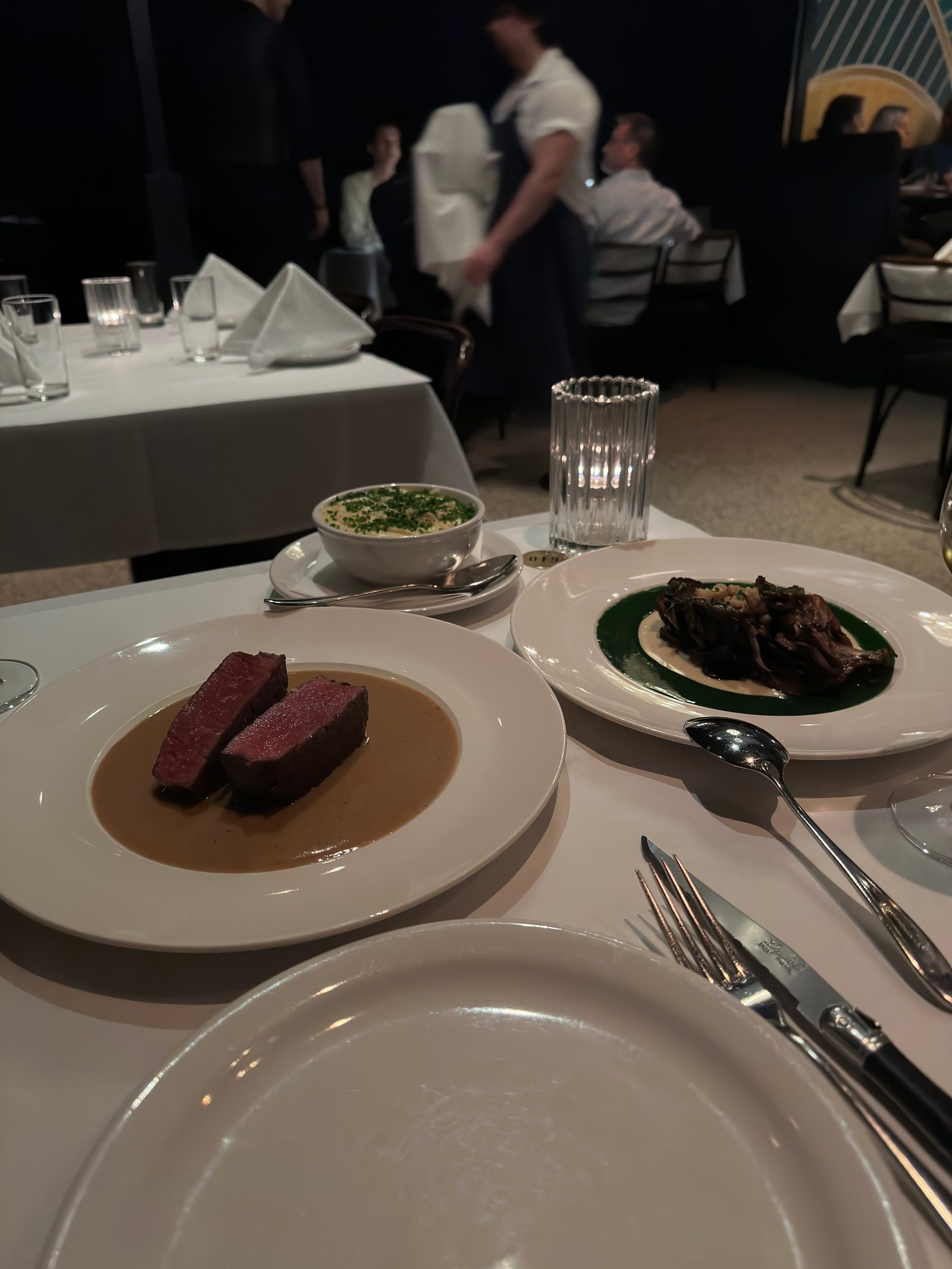
The roasted maitake mushroom is, after many visits, the dish we order without discussion. It is a coil of something that ought, by rights, to be vegetal and is, in execution, almost meaty — the sort of cooking that makes "vegetable forward" sound like the apology it usually is. The lamb neck, when it appears, is excellent: braised to the point of surrender, plated without ceremony.
We must speak about the pommes aligot. They should arrive with a warning label, an apology to your cardiologist, and possibly a waiver. They are pulled, theatrically, into the long ribbons that earn the dish its name. In their molten and overengineered way, they are the best thing on a plate of butter and starch we have eaten in this city. We are not sorry.
The room, the rest
The dining room is dim, but not aggressively so; the music is audible, but does not require negotiation. The wine list, French-leaning and intelligently built, is the work of Mathieu, who can be trusted to find you something interesting at every price tier and who will, if pressed, talk about a Jura producer until your appetizer arrives. The room is run by Sylvain, the General Manager, who is charming and eccentric in roughly equal measure, who remembers names with an accuracy that flatters everyone in the room equally, and who appears to know which of his regulars might want to be seated near – or far from – his other regulars, and seats them accordingly.
A note on cost. La Banane is not cheap, but no restaurant in this city is anymore, and what is striking is how little it has joined the recent procession of Toronto rooms whose prices have crept upward at a rate one can only describe as ambitious. The menu has inflated, but it has inflated like a bread loaf rather than like a balloon.
A note on the crowd. If your evening requires the full flash, the elevated phone, the second pass at the dish for the right angle — this is not your room. The other guests will not stop you.
We do not think La Banane is a great restaurant in the way the press kit means the word. We think it is a great restaurant in the older sense — the sense in which a restaurant is a place you can go, on a Tuesday, with a person you like, and order the maitake and the aligot and a bottle of something Mathieu suggests, and leave full and pleased and a little bit in love with the city again. There are not many of those. There are fewer every year.
Tip accordingly.